Regulations
Connecticut Asbestos Notification: How the Ten-Day Clock Actually Works
Two notification clocks counted differently, the published fee schedule, when notice runs backwards, and what a missed filing actually costs.
Read the postWhat is asbestos abatement and when is it required?
Asbestos abatement is the regulated removal, encapsulation, or enclosure of asbestos-containing materials (ACM) by a licensed contractor. In Connecticut it is required by CT DPH whenever ACM — such as old pipe insulation, floor tile, popcorn ceilings, siding, or joint compound — will be disturbed during renovation, demolition, or water/fire damage repair. Work must occur inside a sealed negative-pressure enclosure built specifically for asbestos, under a licensed Abatement Supervisor.
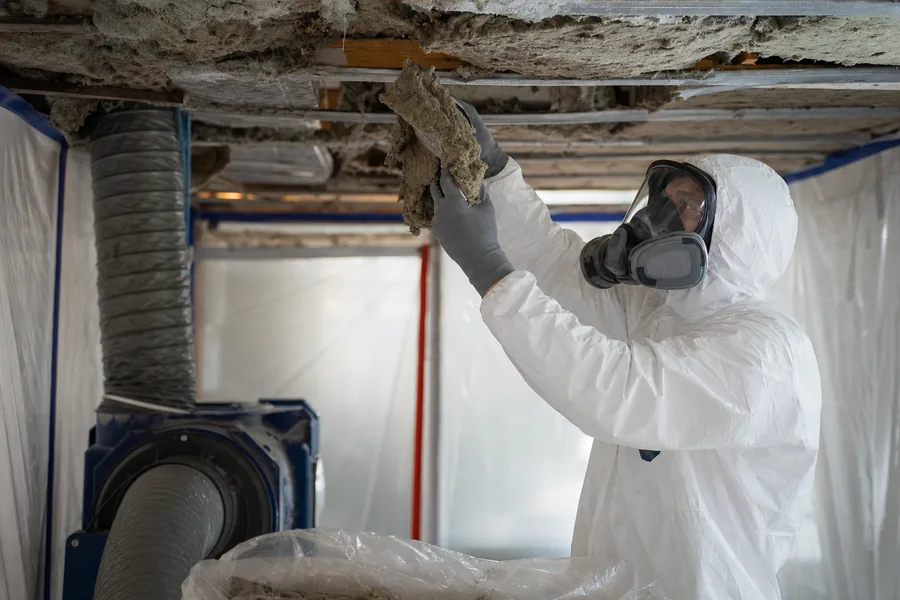
We handle every regulated asbestos material — thermal system insulation, vinyl floor tile and mastic, popcorn/textured ceilings, transite siding, roofing, and joint compound. Each project is performed inside a newly constructed, fully isolated negative-pressure enclosure using unused polyethylene sheeting, sealed penetrations, and compliant airlock/decon chambers, exactly as required under OSHA 29 CFR 1926.1101 and EPA NESHAP.
Containment erected during standard water-mitigation work cannot be reused for asbestos abatement. IICRC S500/S520 containment is designed for moisture and particulate control — not regulated asbestos fibers. CT DPH Asbestos Program regulations (RCSA §19a-332-1 through §19a-332-16) require a new, purpose-built enclosure with proper critical sealing, negative-pressure engineering, and controlled decontamination. Reusing prior containment risks compromised seals, cross-contamination, and failed compliance — so we remove and rebuild between phases.
Every asbestos project is fully documented — scope, regulatory basis, air-monitoring results, waste manifests, and clearance — so homeowners and property managers have what they need for insurance reimbursement and regulatory records.
On-site assessment and coordination of sampling to confirm asbestos-containing materials.
Build a sealed, negative-pressure enclosure with airlocks and a decon chamber.
Wet-remove ACM under HEPA filtration with a licensed supervisor on site.
Air-monitor for clearance and haul waste to a licensed disposal facility, fully documented.
Small residential asbestos jobs typically run $1,200–$3,500, while whole-home or commercial abatement can range from $5,000 to $30,000+. Cost depends on the material, square footage, accessibility, and containment requirements. We provide free written estimates.
No. Connecticut regulations prohibit unlicensed removal of regulated asbestos materials. DIY disturbance releases hazardous fibers and can trigger fines, stop-work orders, and denied insurance claims. Licensed abatement is both safer and legally required.
Most residential projects take 1–3 days including setup, removal, and clearance. Larger or commercial jobs take longer. We give you a clear timeline with your estimate.
Yes — once third-party air-monitoring confirms clearance below regulatory limits and the area passes a visual inspection, the space is safe to reoccupy.
Serving Norwich and all of Eastern Connecticut. Licensed, insured, and ready to coordinate with your insurance adjuster.
Further reading
The rules that govern an abatement project in Connecticut.
Regulations
Two notification clocks counted differently, the published fee schedule, when notice runs backwards, and what a missed filing actually costs.
Read the postRegulations
The exemption everyone quotes is federal, is about something else, and does not override Connecticut licensing. Plus where asbestos actually hides in an older eastern CT home.
Read the postCosts
National marketplace averages, the Connecticut fees that are actually fixed, and the line items a cheap bid quietly omits.
Read the post