Hiring
How to Verify a Connecticut Asbestos Contractor Before You Sign
The free state lookup takes two minutes, the credentials are not interchangeable, and the party certifying that abatement passed cannot be the party that did it.
Read the postWhat is a containment enclosure and why is it critical?
A containment enclosure is a sealed, negative-pressure work area that isolates hazardous materials so fibers and dust cannot escape into occupied spaces. It is the single most important engineering control in asbestos work. A proper enclosure uses unused polyethylene sheeting, fully sealed penetrations, critical barriers, airlocks, a multi-stage decontamination chamber, HEPA-filtered negative air machines, and continuous pressure monitoring — all required under OSHA 29 CFR 1926.1101 and CT DPH regulations.
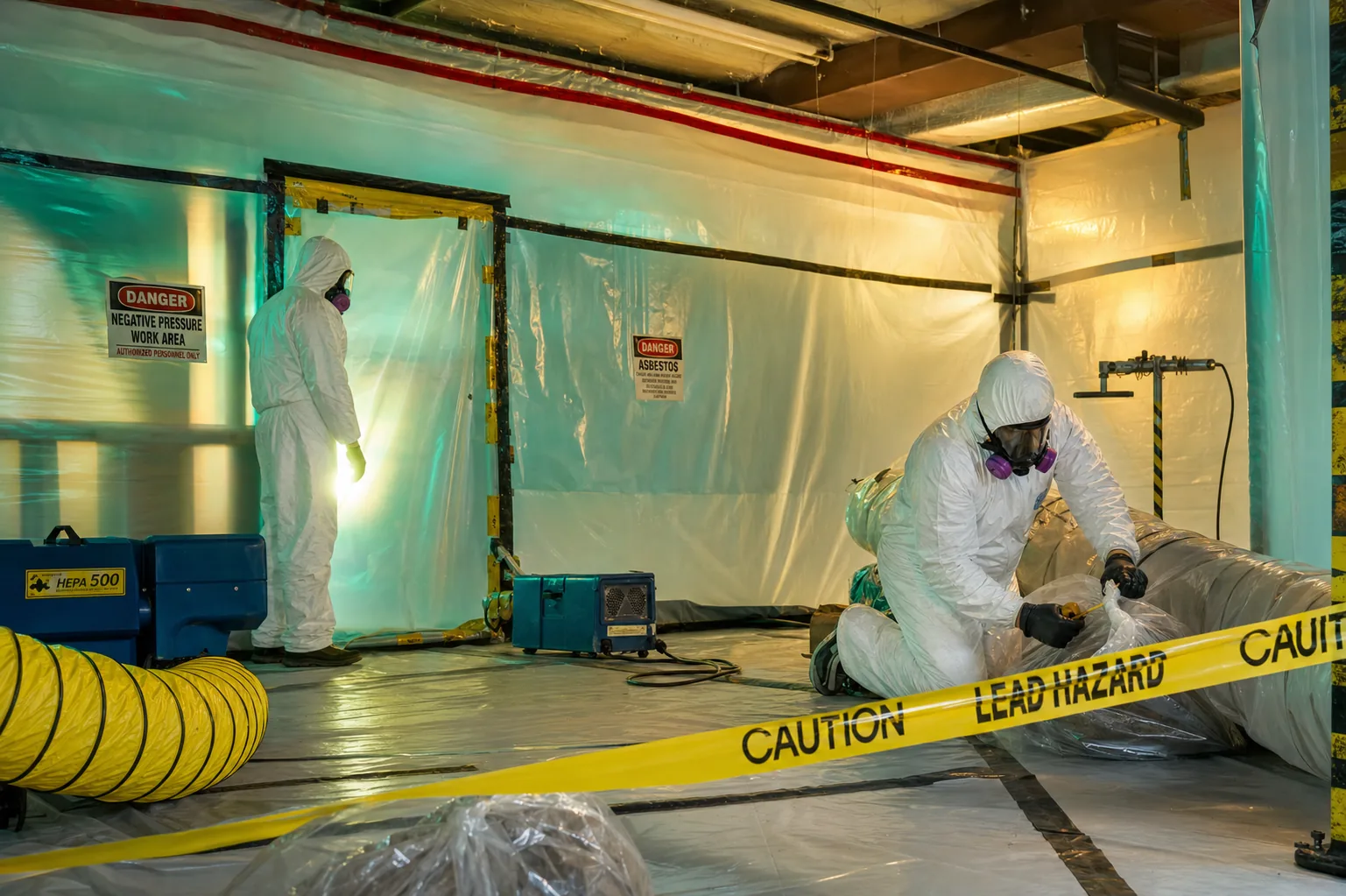
We design and build containment for the specific hazard and site — from single-room residential enclosures to large commercial isolation zones. Every enclosure is constructed to maintain negative pressure relative to surrounding areas, drawing air through HEPA filtration so contaminants are captured, not released.
Our 3-stage decon chambers (clean room, shower, equipment room) allow workers to enter and exit without carrying contamination out of the regulated area. When CT state law requires it, we provide a temporary water hookup to the containment shower for dust control, decontamination, and cleaning.
Because mitigation containment cannot be reused for asbestos abatement, we build new, purpose-built enclosures between phases. This protects negative-pressure integrity, prevents cross-contamination, and keeps the project in full regulatory compliance from start to clearance.
Assess the hazard and site, then design containment sized to the scope.
Erect sealed barriers, airlocks, and a decontamination chamber.
Run HEPA negative-air machines and monitor pressure continuously.
Tear down, HEPA-clean, and verify clearance after work is complete.
Negative pressure containment keeps the air pressure inside the work area lower than the surrounding space, so air flows in (not out). HEPA-filtered negative-air machines continuously capture contaminants and exhaust clean air, preventing fibers and dust from escaping.
Mitigation containment is designed for moisture and category-related contaminants, not regulated asbestos fibers. OSHA, EPA NESHAP, and CT DPH require a newly constructed, fully isolated enclosure with unused sheeting and compliant decon systems for asbestos work.
Yes. We build compliant 3-stage decontamination chambers with a shower, and provide a temporary water hookup where required by CT state law for proper dust control and worker decontamination.
Yes. Engineered containment with critical barriers and negative pressure is specifically designed to allow safe abatement while isolating the rest of an occupied home or commercial building.
Serving Norwich and all of Eastern Connecticut. Licensed, insured, and ready to coordinate with your insurance adjuster.
Further reading
Why containment is built the way it is, and who signs off on it.
Hiring
The free state lookup takes two minutes, the credentials are not interchangeable, and the party certifying that abatement passed cannot be the party that did it.
Read the postEmergency
The cleanup instinct is what turns one room into a whole-house problem. What to do in the first sixty seconds, and the well-meant actions that make it worse.
Read the post